Ministry of Transport, Communications and Information Technology Launches Second Phase of National Digital Economy Program, Targeting OMR 1.5 Billion GDP Contribution by 2030
Date Published: 22 October 2026
The Ministry of Transport, Communications and Information Technology has launched the second phase of the National Digital Economy Program for 2026–2030 under the patronage of H.E. Sultan bin Salim Al Habsi, Minister of Finance. The ceremony brought together ministers, undersecretaries, and representatives of government entities, the private sector, and academic institutions as part of national efforts to increase the digital economy’s contribution to gross domestic product (GDP), support economic diversification, and achieve the targets of Oman Vision 2040.
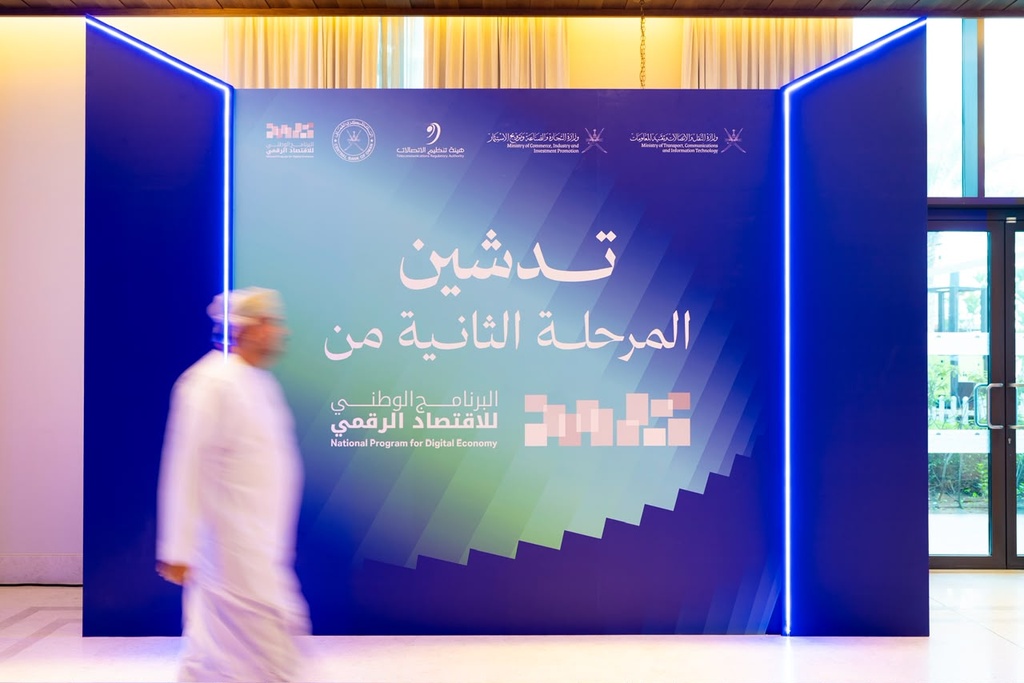
The ceremony featured the announcement that the digital economy accounted for 9% of GDP, based on the findings of a survey conducted this year by the National Centre for Statistics and Information in cooperation with the Ministry. The program’s second phase aims to achieve a digital economy contribution of OMR 1.5 billion to GDP by 2030, attract OMR 300 million in technology investments, and create 3,000 direct jobs annually through digital economy initiatives. This phase focuses on digitalizing strategic economic sectors, expanding the adoption of digital solutions, e-commerce, and electronic payment systems, encouraging small and medium-sized enterprises (SMEs) to embrace digital transformation, and increasing the use of artificial intelligence (AI) applications. These efforts aim to improve efficiency and productivity, advance innovation, and develop domestic digital industries. The ceremony also marked the launch of the National Digital Economy Program’s Strategic Intelligence Platform in cooperation with the World Economic Forum. The platform aims to monitor emerging trends and future developments and use data and knowledge to inform policymaking and decision-making, supporting national priorities and Oman’s digital transformation.
Digital Talent
In his opening address, H.E. Dr. Ali bin Amer Al Shidhani, Undersecretary for Communications and Information Technology at the Ministry of Transport, Communications and Information Technology, said the program places strong emphasis on developing Omani digital talent and skills and increasing Omanis’ participation in technology-related economic activities and occupations. He noted that the Omanization rate in technology-related economic activities rose from 33% in 2022 to 46% in 2026, while the rate in technology occupations increased from 50% to 72% over the same period. More than 5,000 new technology jobs were also created for Omanis over the past five years. Al Shidhani added that the program’s first phase included initiatives to develop specialized skills for the future. These included training more than 170 specialists in semiconductors and 800 specialists in AI, as well as launching a Master of Science in Digital Transformation and Innovation in cooperation with the University of Technology and Applied Sciences. These initiatives aim to equip Omani professionals with the expertise needed to keep pace with rapid developments in the digital sector.
Digital Innovation
Highlighting progress in digital innovation and domestic industries, Al Shidhani said the Ministry had developed a dedicated zone for AI startups and established an AI studio through which 50 intelligent products were developed. It also supported the establishment of 10 Omani startups in the space sector. He added that the Ministry had expanded SME participation in government technology projects by awarding contracts to 251 companies. Other achievements included establishing 48 business incubators and accelerators to support technology startups and providing more than OMR 127 million in financing. These efforts have strengthened the innovation and entrepreneurship ecosystem and supported the growth of domestic digital industries.
Digital Infrastructure
Discussing digital infrastructure and green advanced computing, Al Shidhani highlighted Oman’s progress in international indicators. Oman rose to 22nd globally in the United Nations’ Telecommunications Infrastructure Index in 2024, up from 48th in 2022, and ranked 33rd globally in the International Telecommunication Union’s Digital Readiness Index for 2025. He said the volume of data exchanged through the National Government Integration Platform on the Oman Government Network increased by 391% between 2021 and 2025. Oman’s digital resilience is supported by 20 submarine cables, while high-speed mobile broadband coverage reached 99% of the population. Al Shidhani also outlined plans to establish dedicated AI data centers with a capacity of up to 500 megawatts. These facilities will strengthen the digital infrastructure’s capacity to accommodate advanced technologies and support the transition toward green advanced computing.
Space Sector
Turning to the space sector, Al Shidhani said private sector investment had grown by 270%, employment had increased by 163%, and the number of companies operating in the sector had risen by 136%. Key developments included the launch of Earth observation satellites owned by Omani companies and the start of design and manufacturing work on Oman’s first communications satellite, “OmanSat.” A rocket launch platform also began operations, with two successful test launches conducted. These developments strengthen national capabilities to apply space technologies across various sectors.
Digital Investment
Addressing digital investment, trade, and economic value, Al Shidhani said investment deals and projects announced at COMEX 2025 totaled OMR 116 million, an increase of 45% compared with 2024. He added that 200 technology companies had participated in exhibitions outside Oman over the past three years, signing agreements worth OMR 30 million. The value of e-commerce in Oman reached OMR 288 million in 2025, compared with OMR 221 million in 2023, while investment in the semiconductor sector totaled OMR 88 million. added that the volume of cashless transactions increased by more than 700% between 2020 and 2025.
National Digital Economy Program
The National Digital Economy Program is a strategic program supporting Oman Vision 2040. It comprises eight executive programs covering government digital transformation, artificial intelligence, the cybersecurity industry, space, the digital industry, e-commerce, financial technology, and digital infrastructure. The program is built around three strategic pillars: digital society, digital government, and digital sectors and businesses. These are supported by four key enablers: developing digital infrastructure, strengthening digital policies and governance, developing digital talent and skills, and supporting innovation and domestic digital industries. The program is being implemented in four phases. The first phase, covering 2021–2025, focused on building an integrated digital government. The second, covering 2026–2030, focuses on digitalizing economic sectors. The third, scheduled for 2031–2035, will consolidate domestic digital industries, while the fourth, covering 2036–2040, will strengthen digital exports and global competitiveness. The launch of the second phase builds on national efforts to strengthen coordination between government entities and the private sector and expand the use of digital technologies across economic activities. These efforts support the development of a knowledge- and innovation-based economy and enhance Oman’s competitiveness and its position in the regional and global digital economy.